
Universal Pipette Tips
Disposable pipette tips designed to fit single and multichannel pipettes from most manufacturers; offer acceptable performance compared to pipette specific tips and can be used with a variety of pipette models.
Single-use universal pipette tips are designed for compatibility with most mechanical and electronic single and multichannel pipettors.
Universal pipette tips are available in a range of types, sizes, colors, styles, and packaging configurations and may be designed for specific purposes or tasks.
- Capacity or volume based on the pipettor size
- Filters to reduce contamination and cross-contamination
- Color
- Sterility or autoclavability
- Tip style: beveled, tapered, wide bore, round, flat, or gel-loading
- Length: short or extended
- Purity: metal-free or DNase-, RNase-, ATP-, Bioburden-, PCR inhibitor-, endotoxin-, or pyrogen-free for genomic and biologic applications
- Surface treatments to reduce retention
- Packaging options to help facilitate re-stocking or eliminate waste


ABclonal Technology DUSP15 Rabbit pAb

The protein encoded by this gene has both protein-tyrosine phophatase activity and serine/threonine-specific phosphatase activity, and therefore is known as a dual specificity phosphatase. This protein may function in the differentiation of oligodendrocytes. Alternative splicing results in multiple transcript variants.


ABclonal Technology NCSTN Rabbit pAb
This gene encodes a type I transmembrane glycoprotein that is an integral component of the multimeric gamma-secretase complex. The encoded protein cleaves integral membrane proteins, including Notch receptors and beta-amyloid precursor protein, and may be a stabilizing cofactor required for gamma-secretase complex assembly. The cleavage of beta-amyloid precursor protein yields amyloid beta peptide, the main component of the neuritic plaque and the hallmark lesion in the brains of patients with Alzheimers disease, however, the nature of the encoded proteins role in Alzheimers disease is not known for certain. Mutations in this gene are associated with familial acne inversa. A pseudogene of this gene is present on chromosome 21. Alternatively spliced transcript variants of this gene have been described, but the full-length nature of some of these variants has not been determined.
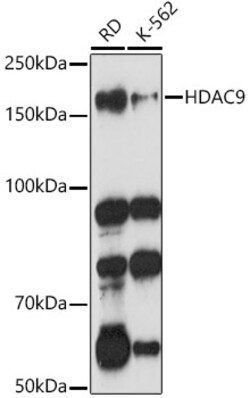
ABclonal Technology HDAC9 Rabbit pAb
Histones play a critical role in transcriptional regulation, cell cycle progression, and developmental events. Histone acetylation/deacetylation alters chromosome structure and affects transcription factor access to DNA. The protein encoded by this gene has sequence homology to members of the histone deacetylase family. This gene is orthologous to the Xenopus and mouse MITR genes. The MITR protein lacks the histone deacetylase catalytic domain. It represses MEF2 activity through recruitment of multicomponent corepressor complexes that include CtBP and HDACs. This encoded protein may play a role in hematopoiesis. Multiple alternatively spliced transcripts have been described for this gene but the full-length nature of some of them has not been determined.
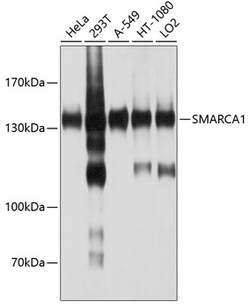
ABclonal Technology SMARCA1 Rabbit pAb
This gene encodes a member of the SWI/SNF family of proteins. The encoded protein is an ATPase which is expressed in diverse tissues and contributes to the chromatin remodeling complex that is involved in transcription. The protein may also play a role in DNA damage, growth inhibition and apoptosis of cancer cells. Alternative splicing results in multiple transcript variants.
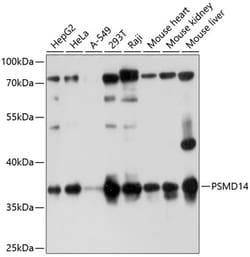
ABclonal Technology PSMD14 Rabbit pAb
This gene encodes a component of the 26S proteasome. The 26S proteasome is a large multiprotein complex that catalyzes the degradation of ubiquitinated intracellular proteins. The encoded protein is a component of the 19S regulatory cap complex of the 26S proteasome and mediates substrate deubiquitination. A pseudogene of this gene is also located on the long arm of chromosome 2.

ABclonal Technology KIR3DL3 Rabbit pAb
Killer cell immunoglobulin-like receptors (KIRs) are transmembrane glycoproteins expressed on natural killer cells and some T cells. Encoded by polymorphic and homologous genes clustered at chromosome 19q13.4 within the 1 Mb leukocyte receptor complex (LRC), KIR gene content varies among haplotypes, though framework genes like KIR3DL3, KIR3DP1, KIR3DL4, and KIR3DL2 are always present. KIRs are classified by the number of extracellular domains (2D or 3D) and cytoplasmic tail length. Long-tailed KIRs deliver inhibitory signals via ITIMs, while short-tailed KIRs lack ITIMs and activate signals through TYRO binding protein. Many KIRs recognize subsets of HLA class I molecules, playing key roles in immune regulation. This gene is one of the universally present framework loci.

ABclonal Technology IDH3A Rabbit pAb
Isocitrate dehydrogenases catalyze the oxidative decarboxylation of isocitrate to 2-oxoglutarate. These enzymes belong to two distinct subclasses, one of which utilizes NAD(+) as the electron acceptor and the other NADP(+). Five isocitrate dehydrogenases have been reported three NAD(+)-dependent isocitrate dehydrogenases, which localize to the mitochondrial matrix, and two NADP(+)-dependent isocitrate dehydrogenases, one of which is mitochondrial and the other predominantly cytosolic. NAD(+)-dependent isocitrate dehydrogenases catalyze the allosterically regulated rate-limiting step of the tricarboxylic acid cycle. Each isozyme is a heterotetramer that is composed of two alpha subunits, one beta subunit, and one gamma subunit. The protein encoded by this gene is the alpha subunit of one isozyme of NAD(+)-dependent isocitrate dehydrogenase.

ABclonal Technology MYOCD Rabbit pAb
This gene encodes a nuclear protein, which is expressed in heart, aorta, and in smooth muscle cell-containing tissues. It functions as a transcriptional co-activator of serum response factor (SRF) and modulates expression of cardiac and smooth muscle-specific SRF-target genes, and thus may play a crucial role in cardiogenesis and differentiation of the smooth muscle cell lineage. Alternatively spliced transcript variants encoding different isoforms have been found for this gene.

ABclonal Technology SLC29A3 Rabbit pAb
This gene encodes a nucleoside transporter. The encoded protein plays a role in cellular uptake of nucleosides, nucleobases, and their related analogs. Mutations in this gene have been associated with H syndrome, which is characterized by cutaneous hyperpigmentation and hypertrichosis, hepatosplenomegaly, heart anomalies, and hypogonadism. A related disorder, PHID (pigmented hypertrichosis with insulin-dependent diabetes mellitus), has also been associated with mutations at this locus. Alternatively spliced transcript variants have been described.
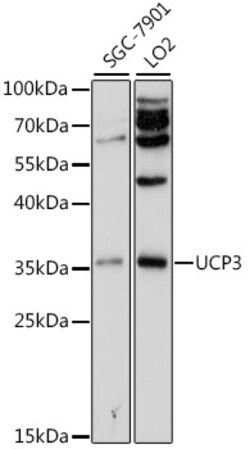
ABclonal Technology UCP3 Rabbit pAb
Mitochondrial uncoupling proteins (UCPs) are part of the mitochondrial anion carrier protein (MACP) family. They uncouple oxidative phosphorylation from ATP synthesis, dissipating energy as heat, known as the mitochondrial proton leak. UCPs transfer anions across the mitochondrial membrane and reduce the mitochondrial membrane potential. The expression of UCPs varies by tissue; this gene is primarily expressed in skeletal muscle. Its protein product is believed to protect mitochondria from lipid-induced oxidative stress. When fatty acid supply exceeds oxidation capacity, UCP facilitates the export of excess fatty acids from mitochondria. UCPs contain three solcar protein domains typical of MACPs. Two splice variants of this gene have been identified.

ABclonal Technology GSTA1 Rabbit pAb
This gene encodes a member of a family of enzymes that function to add glutathione to target electrophilic compounds, including carcinogens, therapeutic drugs, environmental toxins, and products of oxidative stress. This action is an important step in detoxification of these compounds. This subfamily of enzymes has a particular role in protecting cells from reactive oxygen species and the products of peroxidation. Polymorphisms in this gene influence the ability of individuals to metabolize different drugs. This gene is located in a cluster of similar genes and pseudogenes on chromosome 6. Alternative splicing results in multiple transcript variants.

ABclonal Technology SERCA1/ATP2A1 Rabbit pAb
This gene encodes one of the SERCA Ca(2+)-ATPases, which are intracellular pumps located in the sarcoplasmic or endoplasmic reticula of muscle cells. This enzyme catalyzes the hydrolysis of ATP coupled with the translocation of calcium from the cytosol to the sarcoplasmic reticulum lumen, and is involved in muscular excitation and contraction. Mutations in this gene cause some autosomal recessive forms of Brody disease, characterized by increasing impairment of muscular relaxation during exercise. Alternative splicing results in three transcript variants encoding different isoforms.

ABclonal Technology SLIRP Rabbit pAb
Steroid receptor RNA activator (SRA, or SRA1, MIM 603819) is a complex RNA molecule containing multiple stable stem-loop structures that functions in coactivation of nuclear receptors. SLIRP interacts with stem-loop structure-7 of SRA (STR7) and modulates nuclear receptor transactivation (Hatchell et al., 2006 [PubMed 16762838]).

ABclonal Technology PTCD1 Rabbit pAb
This gene encodes a mitochondrial protein that binds leucine tRNAs and other mitochondrial RNAs and plays a role in the regulation of translation. Increased expression of this gene results in decreased mitochondrial leucine tRNA levels. Naturally occurring read-through transcription exists between upstream ATP5J2 (ATP synthase, H+ transporting, mitochondrial Fo complex, subunit F2) and this gene.

ABclonal Technology P2RY10 Rabbit pAb
The protein encoded by this gene belongs to the family of G-protein coupled receptors that are preferentially activated by adenosine and uridine nucleotides. There is a pseudogene for this gene nearby on chromosome X. Multiple alternatively spliced transcripts have been observed.